Group sessions that work for the member who joined today and the one stepping down Thursday.

A mental health group therapy curriculum for adult IOP and PHP programs with rolling admission. Every session stands on its own, so you never have to choose between orienting a newcomer and moving the group forward.

Reviewed before publication by practicing clinicians, and already in use in clinical group work.

Rolling admission over three weeks Seven group members on a three-week calendar. Each joined on a different day. A vertical line marks today's session, where one member is on their first day, others are on days two to six or in week three, and one is stepping down. Week 1 Week 2 Week 3 MTWTF MTWTF MTWTF Stepping down Week 3 Day 6 Day 5 Day 3 Day 2 First day Today's group
One room, seven starting points. Each session in the curriculum is written for this group, not for a cohort that started together.

Built around the problem closed-cohort curricula skip

Most group curricula assume everyone starts and finishes together. In a rolling-admission program, the facilitator runs a group where some members are new and some have heard every skill before. These are the parts of each session written for that.

Newcomer Bridge
Every rotation session opens with a short scripted orientation that brings a first-day member up to speed without making returning members sit through a recap.
Two sets of processing questions
Each session closes with separate questions for first-time and returning members, so both get something to work on.
No session depends on another
Sessions run on a six-week rotation that any member can join on any day. Catch-up pages cover anything a member missed before stepping down.
Documentation language
Sample GIRP and DAP notes for every Skills, Psychoeducation and PHP session, and a documentation cue for every Process group.
Ready-made rotation calendars
Schedules for 3-day IOP, 4-day extended IOP and 5-day PHP programs, plus a holiday and closure protocol.

The Open-Enrollment Program Series

Two volumes that work together: the facilitator curriculum and the matching client worksheets, sharing the same session codes.

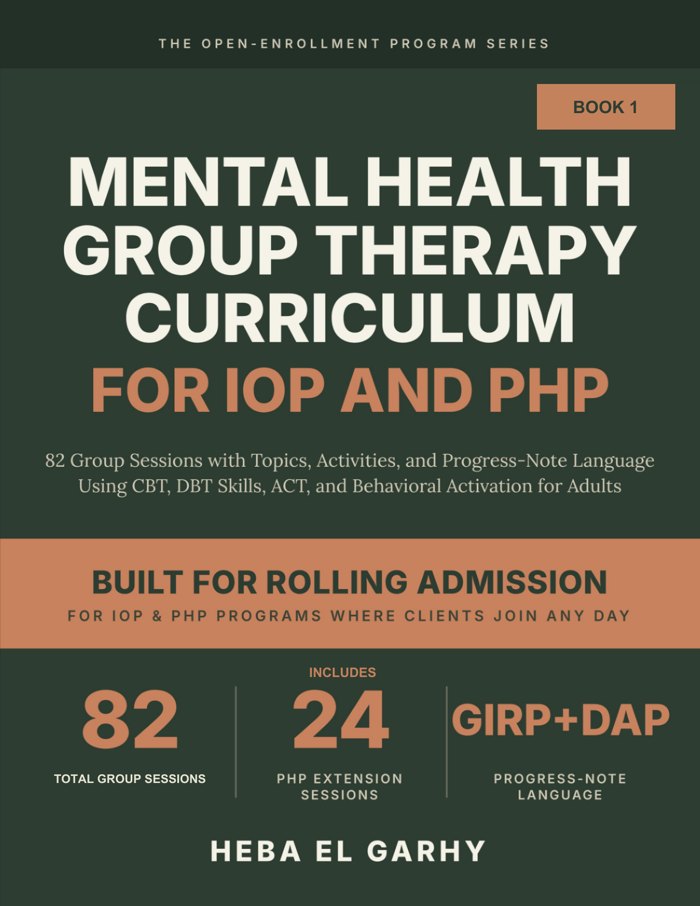
Cover of Mental Health Group Therapy Curriculum for IOP and PHP, Volume 1

Volume 1 · For facilitators

Mental Health Group Therapy Curriculum for IOP and PHP

82 group sessions using CBT, DBT skills, ACT and Behavioral Activation, adapted for group delivery.

  • 18 Process, 18 Skills and 18 Psychoeducation sessions, plus 24 PHP Extension sessions
  • 4 special protocols: orientation, step-down, critical-incident debrief and low attendance
  • Topics adults bring to group: depression, anxiety and panic, sleep and mood, trauma and triggers, shame, anger, grief, loneliness, boundaries and relapse prevention
  • Facilitation guides with teaching points, activities, telehealth adaptations and suggested responses for difficult moments
Cover of Mental Health Group Therapy Worksheets for Adults, Volume 2

Volume 2 · For clients

Mental Health Group Therapy Worksheets for Adults

78 reproducible client worksheets, one for each rotation session in Volume 1.

  • A consistent layout: an in-group exercise, a tracking grid, a 0–10 reflection and one small next step
  • The Rotation Passport, a client-held record of all 82 program sessions
  • Six catch-up pages, one per skills module
  • A cut-out personal crisis and support card

Coming soon: When Group Gets Stuck

A practical response guide for the moments that derail adult IOP and PHP skills groups, written for the facilitator who can't leave the room. See all 39 situations and download a free sample.

Response guide · For facilitators, trainees and supervisors

When Group Gets Stuck: A Practical Response Guide for Adult IOP and PHP Skills Groups

39 scenarios, each with three ways to respond, what to do next, a way back to the planned DBT skill, and documentation examples.

  • Find the situation, say the first sentence, choose the next step
  • Solo and co-facilitator routes for every scenario
  • Acute moments and video groups, with a Safety first page
  • 39 one-page quick-reference cards, with a printable pack for purchasers

From clinicians who have used it

"The book is excellent and fills several gaps I have encountered in previous group therapy resources. I find it practical and easy to use during sessions, and I have come to rely on it in my clinical work."

Dr. Salwa Ismael HegazyPhD in Clinical Neuropsychology · The American University in Cairo

The books were used during her training at Abbasiya Mental Health Hospital, where she found they made the doctors' work much easier.

Erena JabrialBSc Psychology, University of Greenwich · Trainee, Abbasiya Mental Health Hospital

Affiliations are listed for identification only and do not imply endorsement by any institution.

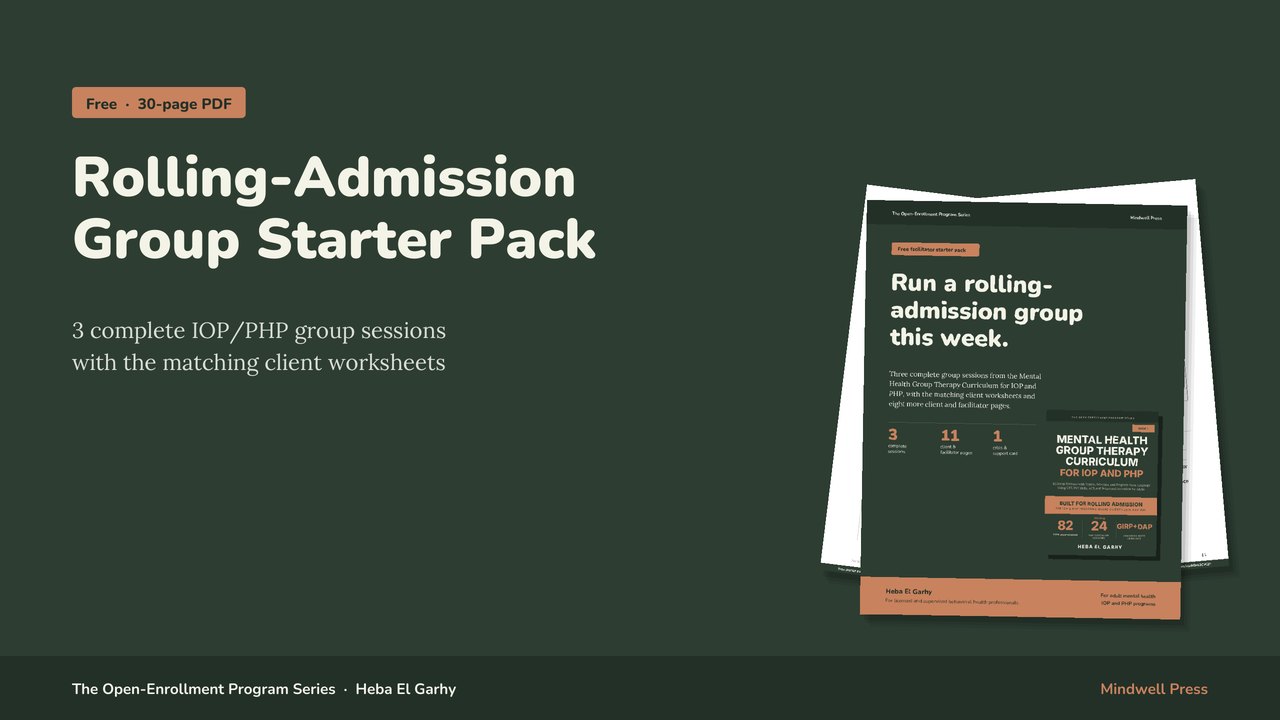
The free Rolling-Admission Group Starter Pack: cover and sample pages

Try three sessions with your group first

A free 30-page PDF, sent to your email right away. Run a session with a real group and decide from there.

  1. Three complete sessions: one Process, one Skills, one Psychoeducation, each with its Newcomer Bridge
  2. The client worksheet for each session
  3. How the rotation works and the anatomy of every session
  4. Eight more pages, including the Rotation Passport and a crisis and support card

Using the worksheets across a program

The worksheets are licensed for reproduction by the purchasing clinician or program, for the clients in their care.

One facilitatorBuy Volume 2 and copy pages for the clients in your groups.
A whole programFor several facilitators or sites, email hello@thoughtkindpress.com with your program size, and we'll reply with team options.

About the author

Heba El Garhy is a behavioral health author and researcher with a background spanning biotechnology, clinical sciences and applied psychology. She is pursuing postgraduate studies in Psychology at Cairo University and holds professional diplomas in educational psychology, counseling and human development. Her work focuses on turning clinical frameworks into tools that hold up in a real session. More about the author and our editorial standards.

New to open-enrollment groups? Read how to run a rolling-admission therapy group.